2026-08-22
Baking Soda, Vinegar, and Castile Soap: What Actually Cleans What (From Somebody Who Does It All Day)
We run on ECOS Pro for most of what we do, and it's good stuff. But lately I've started making a few of my own cleaners — a window cleaner, an all-surface spray, an oven paste, and a tile-and-grout scrub built on soap I make from scratch. I've got three reasons, and none of them are that I think I'm a chemist. One, it's cheaper. Two, it's healthier and safer to be breathing all day when this is your actual job. And three — this is the big one — I like knowing exactly what's in the bottle. When you're cleaning somebody's home, "exactly what's in the bottle" isn't a small thing.
Now, fair warning: I'm still early in this. I do my homework before I mix anything, but I'm going off what I've found and what's worked in my hands, not a lab coat and a clipboard. Some of what I "knew" turned out to be wrong once I dug in — I'll show you one of those below, because I think getting it wrong out loud is more useful than pretending I had it right the whole time. There are almost certainly better methods than mine, and honestly, that's the fun part. I'm always looking for the better way, and you should be too.
Three ingredients do most of the work in the homemade world: baking soda, vinegar, and castile soap. The single most useful thing to understand about all three is dead simple, so let's start there.
The one idea that makes all of this make sense: acids and bases
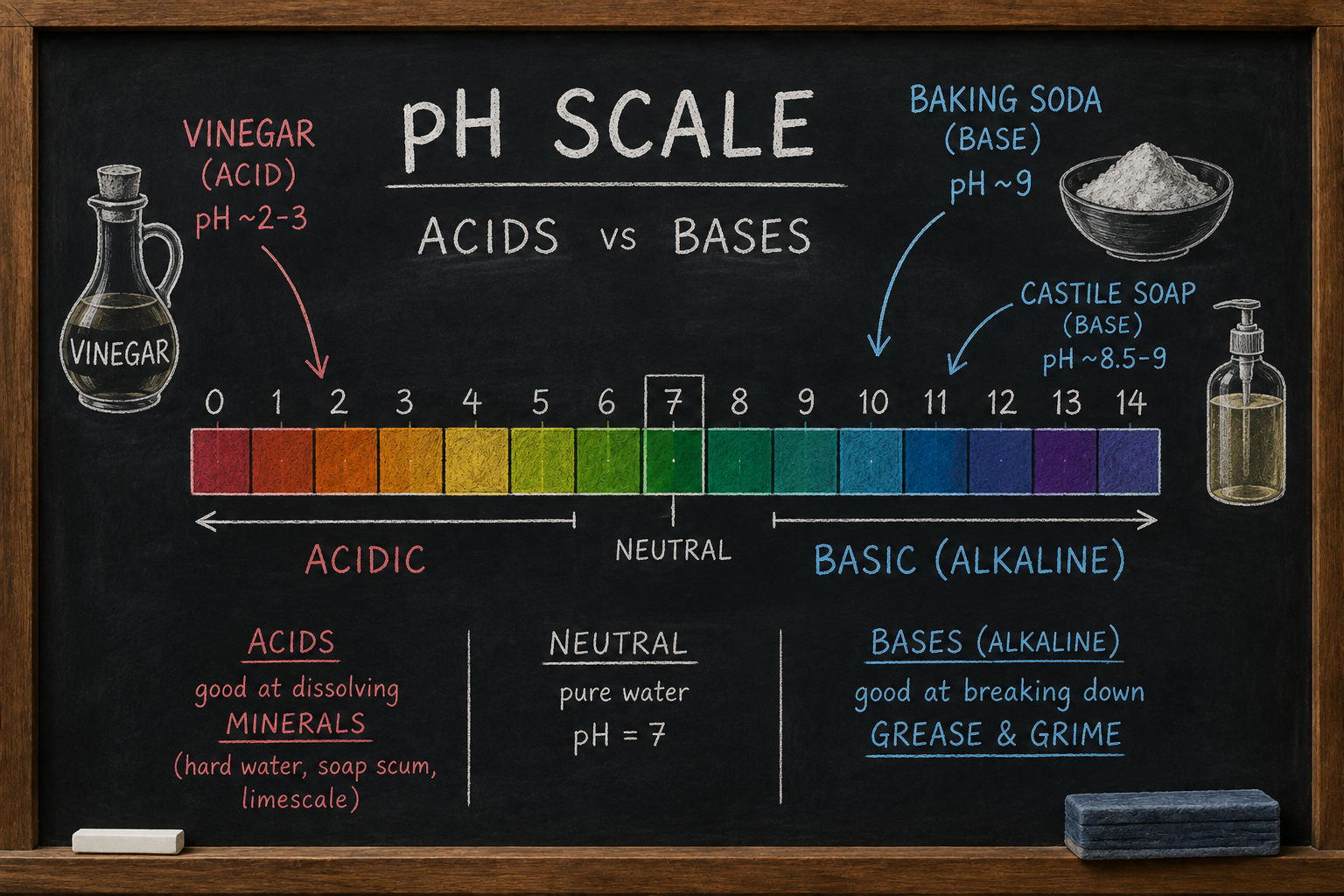
Everything here comes down to one thing from high-school chemistry. Some cleaners are acids, some are bases (the fancier word is "alkaline"), and they do opposite jobs.
- Baking soda is a base. It sits around pH 9, and it's good at grease and grime, plus a little gentle scrubbing.
- Castile soap is also a base. It's mildly alkaline, right around pH 8.9 — very close to baking soda, which is exactly why the two play nicely together.
- Vinegar is an acid. It's about 5% acetic acid, and acids are great at dissolving minerals — hard-water crust, soap scum, limescale.
Here's the punchline you can tape to the inside of your cleaning cabinet: bases go with bases. Acids stay in their own bottle. Baking soda and castile soap are teammates. Vinegar is a loner — it does great work, but the second you mix it with the other two, everybody loses. I'll show you why as we go.
Baking soda: the gentle muscle
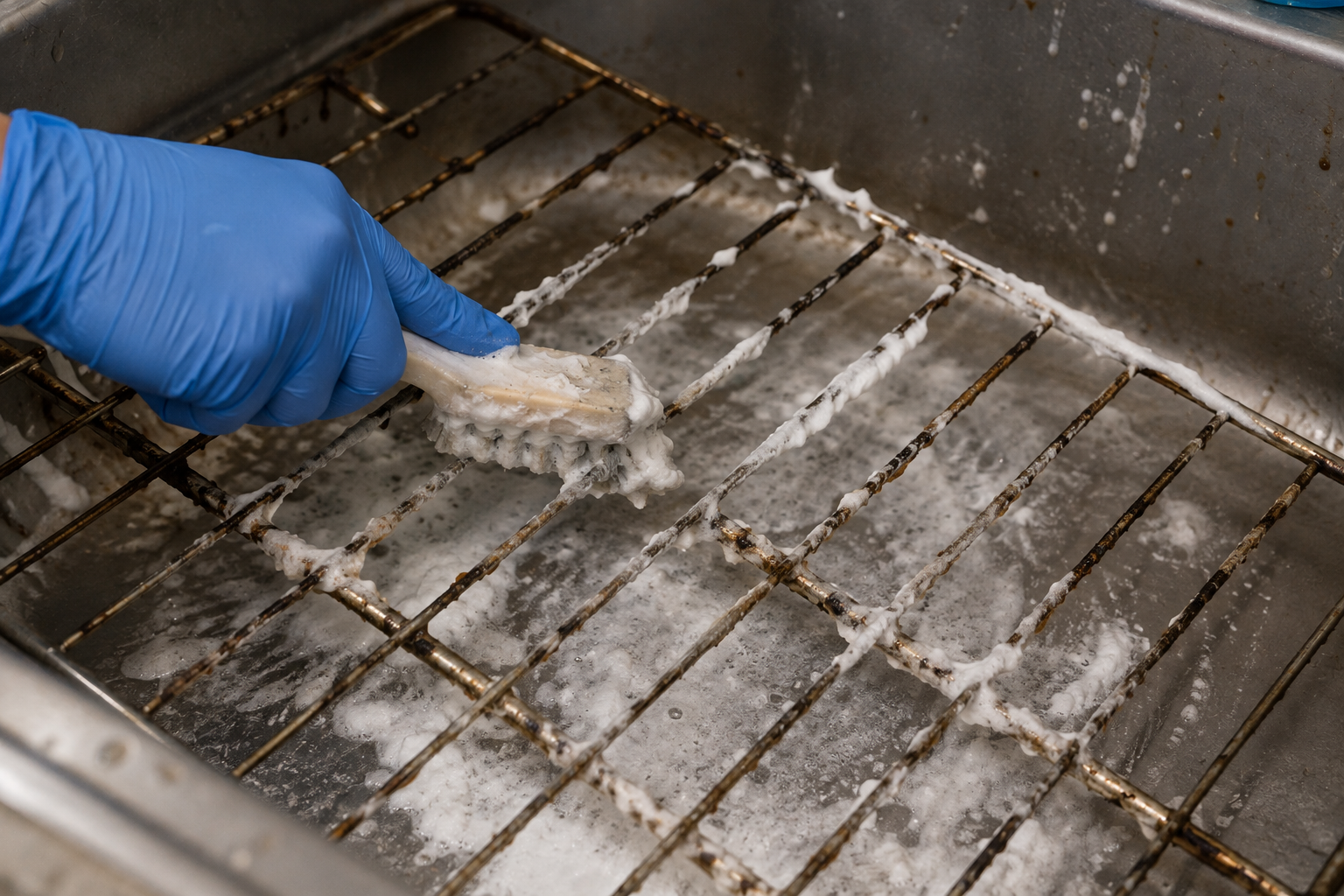
Baking soda is sodium bicarbonate. Two things make it useful. First, as a mild base it breaks down grease and the sticky, grimy stuff that builds up in a kitchen. Second, it's a gentle abrasive — and I mean gentle. On the hardness scale the sandblasting folks use, baking soda comes in around 2.5, just above talc, way down at the soft end. That's the whole magic trick: hard enough to scrub off baked-on gunk, soft enough that it usually won't scratch the surface underneath the way a harsh powder or a green scrubby will.
It's also an honest deodorizer. It doesn't cover a smell with a stronger smell — it neutralizes the acids that cause a lot of odors in the first place. That open box in the back of the fridge? That's the real deal, not folklore.
A quick tangent, because I think it's neat: baking soda is the same stuff that made Irish soda bread possible. Before it came along, bakers leaned on weaker leaveners like pearl ash (potash) from wood ashes to get bread to rise without yeast. When bicarbonate of soda became available in Ireland in the 1830s, it took over fast — it was simply stronger and more reliable. The oldest known published Irish soda bread recipe ran in an 1836 newspaper, the Newry Telegraph, and called for wheaten meal, salt, "super-carbonate of soda," and very sour buttermilk — the acidic buttermilk reacting with the soda is what puffs the loaf up. If you want to watch someone actually bake the 1836 version and walk through the history, Max Miller's Tasting History episode on it is a great watch. Same humble box in your cabinet, a couple hundred years of history.
Where I reach for it: scrubbing sinks, tubs, and stovetops with baked-on residue; cutting grease around the range; deodorizing fridges, cans, and carpets; and — the two big ones for us — oven cleaning and tile and grout, which I'll get to.
Where it lets you down: because it's abrasive, keep it off the stuff you'd keep any abrasive off of — glass cooktops, mirrors, stainless steel, and natural stone, where over time it can dull or fine-scratch the finish. It also loves to hide in grout lines as a white film if you don't rinse well. And it does not dissolve hard-water scale — that's an acid's job, which is vinegar's whole reason for living.
Castile soap: the base I make from scratch
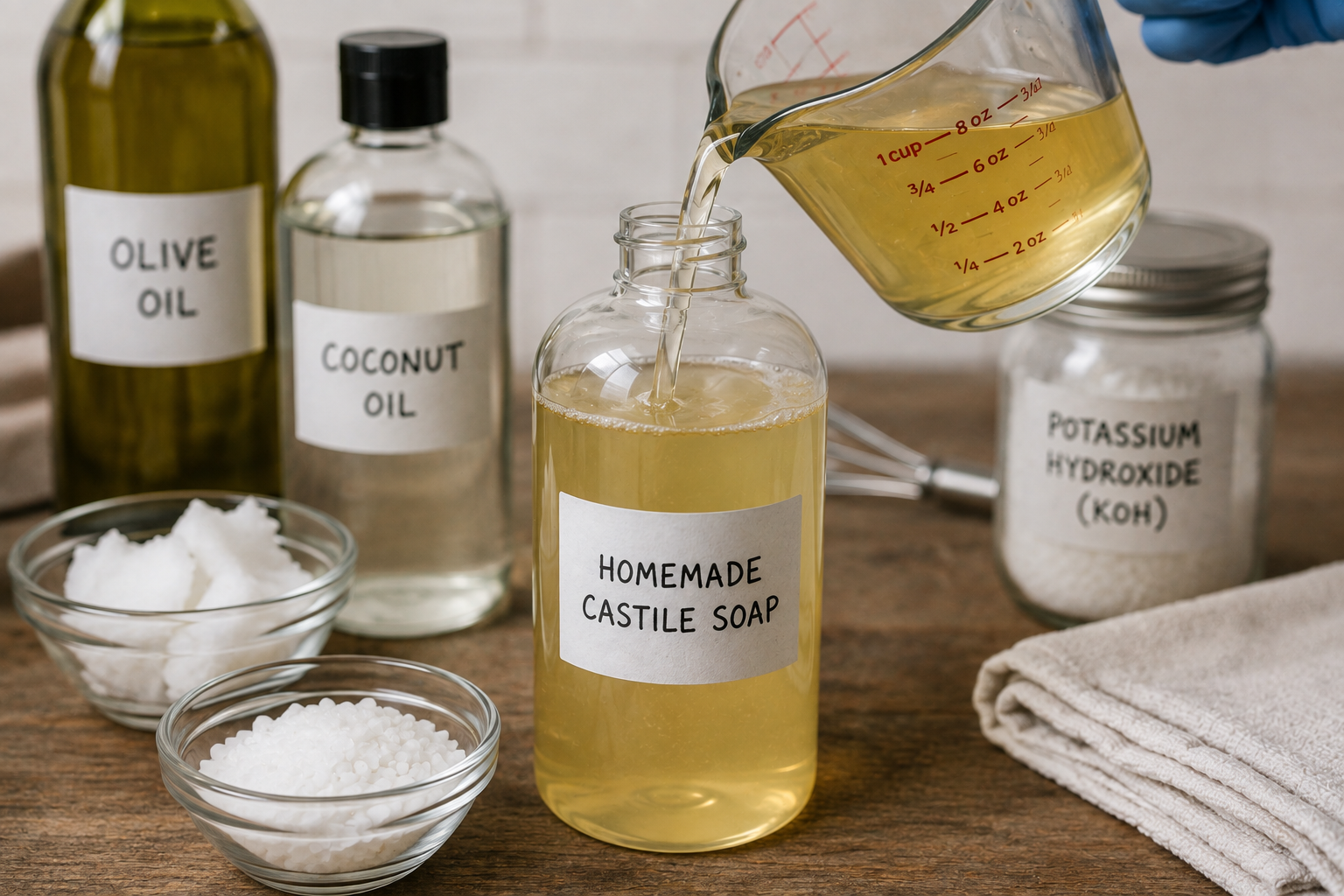
This is the one I'm proudest of, because I make the soap itself. Castile soap is an old, plant-based soap — named for the Castile region of Spain, made by saponifying vegetable oils instead of using animal fat or synthetic detergents. Mine is mostly coconut oil with some olive oil, turned into soap with potassium hydroxide (KOH). Quick ingredient tour, since I promised to explain what's in the bottle:
- Olive oil — the classic castile base. Gentle, mild, doesn't lather much but cleans soft.
- Coconut oil — brings the lather and the cleaning punch. I lean on this one more heavily.
- Potassium hydroxide (KOH) — the "lye" that turns oil into soap. Here's the thing people miss: liquid soap uses potassium hydroxide, while bar soap uses sodium hydroxide (NaOH) — they're not interchangeable. KOH is what keeps the soap pourable.
I'm going to be straight with you: making soap means handling lye, and lye is dangerous — it can cause serious chemical burns and blindness. If you decide to try it, you do so at your own risk: wear gloves and goggles, work with ventilation, always add the lye to the water and never the reverse, and keep it away from kids and pets. A workable starting formula is roughly 60% olive oil, 40% coconut oil, saponified with KOH at about a 3% superfat, cooked to a paste and diluted with distilled water — but do not eyeball it, and do not take my word as gospel. Every oil needs a different amount of KOH, so run any recipe through a soap calculator like SoapCalc before you make it. I'll write up my full process, done properly, in its own post down the road. Nothing here is professional soap-making or safety instruction — it's just what I do.
If you don't want to make soap — and most people reasonably don't — any store-bought liquid castile soap (Dr. Bronner's is the common one) or a plain liquid dish soap works in the recipes below.
One honest note: castile soap cleans by lifting dirt and grease, but it doesn't kill germs, and in hard water it can leave a slight soapy film — distilled or filtered water fixes that. It's a cleaner, not a disinfectant. (Big theme coming up.)
Vinegar: the acid that dissolves what soda can't
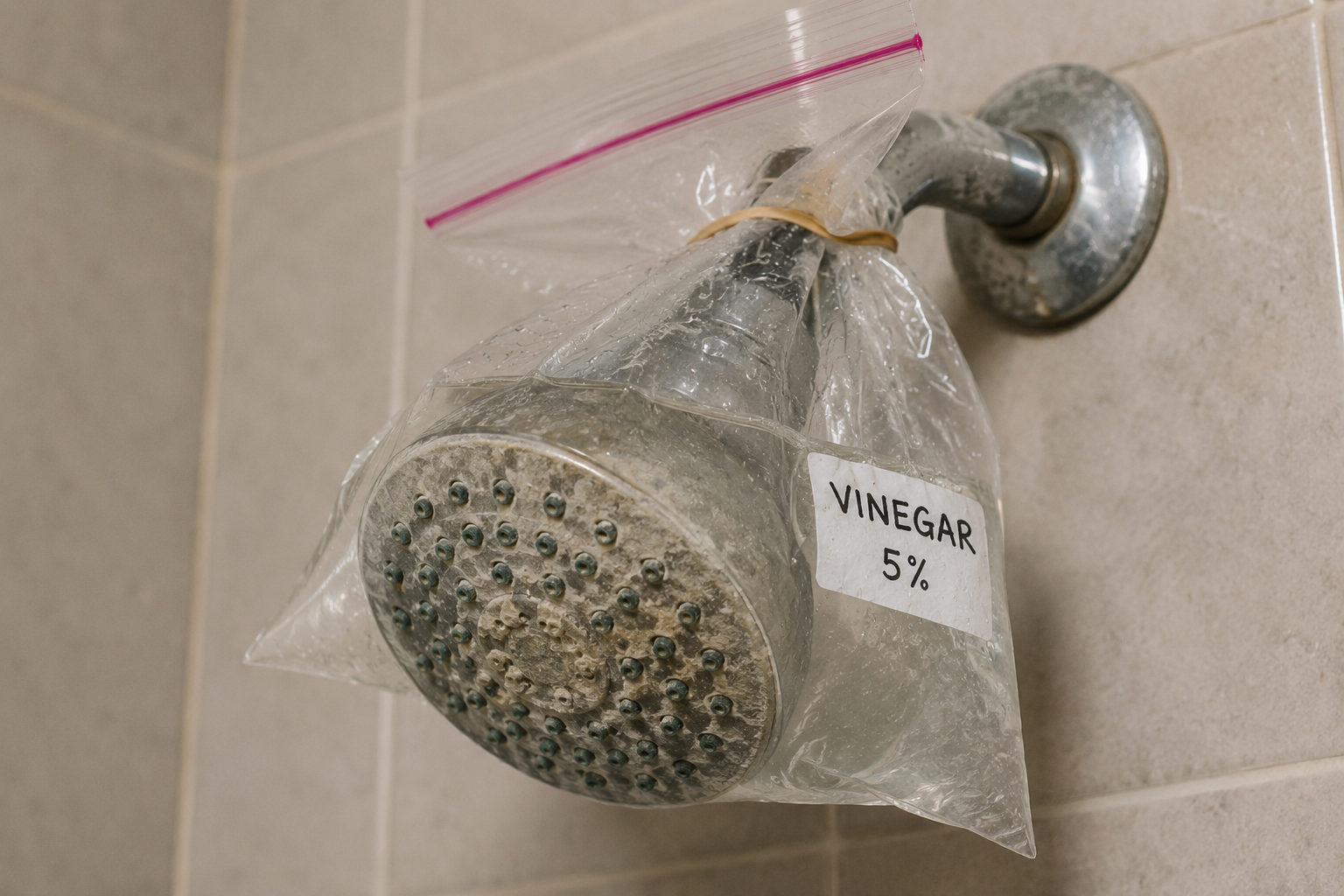
White vinegar does the opposite job from baking soda and soap. Where those two are bases that handle grease, vinegar is an acid that eats minerals. That chalky white crust on a showerhead or faucet is calcium carbonate, and the acid in vinegar turns it into something water-soluble that just rinses away. That's why a vinegar-soaked bag rubber-banded over a grimy showerhead overnight works so well — no scrubbing, just chemistry and patience.
And patience is the real trick, not strength. You can buy "cleaning vinegar" at 6–10%, but the pros will tell you stronger mostly means riskier, not better — it etches finishes faster. Regular 5% vinegar and a little time handles almost everything.
Where I reach for it: hard-water spots and soap scum on glass, chrome, and ceramic; faucets and showerheads; and general multi-surface wipe-downs and windows (recipes below).
Where it lets you down — and this is where a lot of DIY blogs are quietly steering people wrong:
- Natural stone — marble, granite, limestone. Acid etches it and leaves permanent dull spots. Never.
- Grout — this one surprises people. Acid reverses the reaction that sealed your grout and can leech the color right out of it over time. Half the "clean your grout with vinegar!" advice online is slowly wrecking the grout.
- Grease — vinegar's weak on it. That's baking soda's department.
- Rubber seals — it can break them down over time, so go easy around appliance gaskets.
And one that isn't a preference, it's a hard line: never mix vinegar with bleach. It makes toxic chlorine gas. Not ever. Not "in a well-ventilated room." Not ever.
The myth everybody falls for: mixing them together
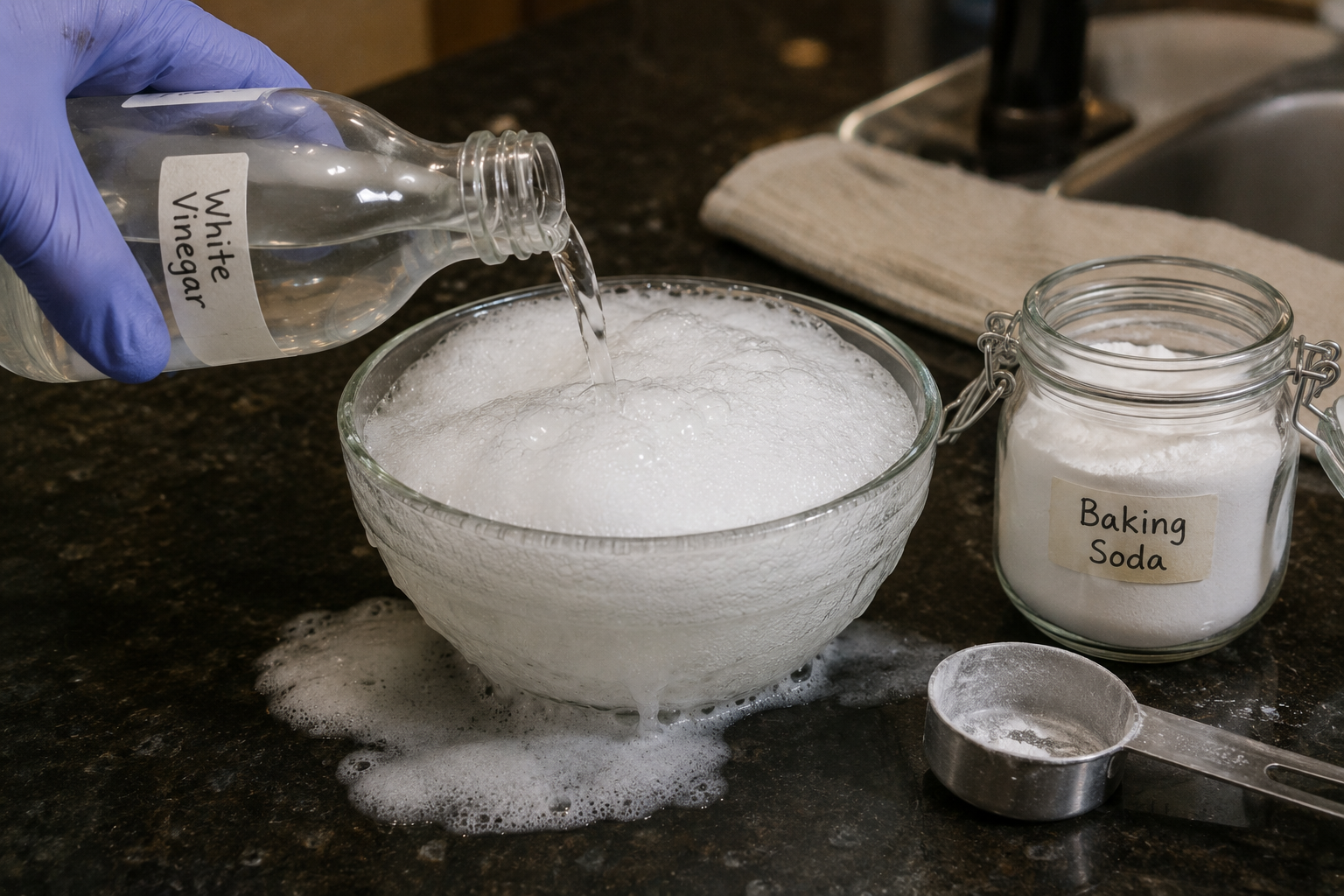
Here's the one that fools everybody. Dump vinegar on baking soda, it erupts like a third-grade science fair, and it looks like raw cleaning power. It isn't. You've got an acid and a base, and when they meet they cancel each other out — you're left with mostly salt water and a bunch of carbon dioxide. You took two good cleaners and made one weak one. Great volcano. Lousy cleaner.
Same deal — and this one's less famous, so listen up — with vinegar and castile soap. Pour acid into that soap and it "unsaponifies" — the soap curdles into a whitish, oily, cottage-cheese mess that cleans nothing and leaves a film. I've seen people mix up a "natural all-purpose cleaner" of vinegar + castile soap + water and wonder why their counters feel greasy. That's why.
So the rule, one more time, because it's the most useful thing in this whole post: baking soda and castile soap are friends. Vinegar works alone. Bases with bases, acid on its own.
The recipes I actually use
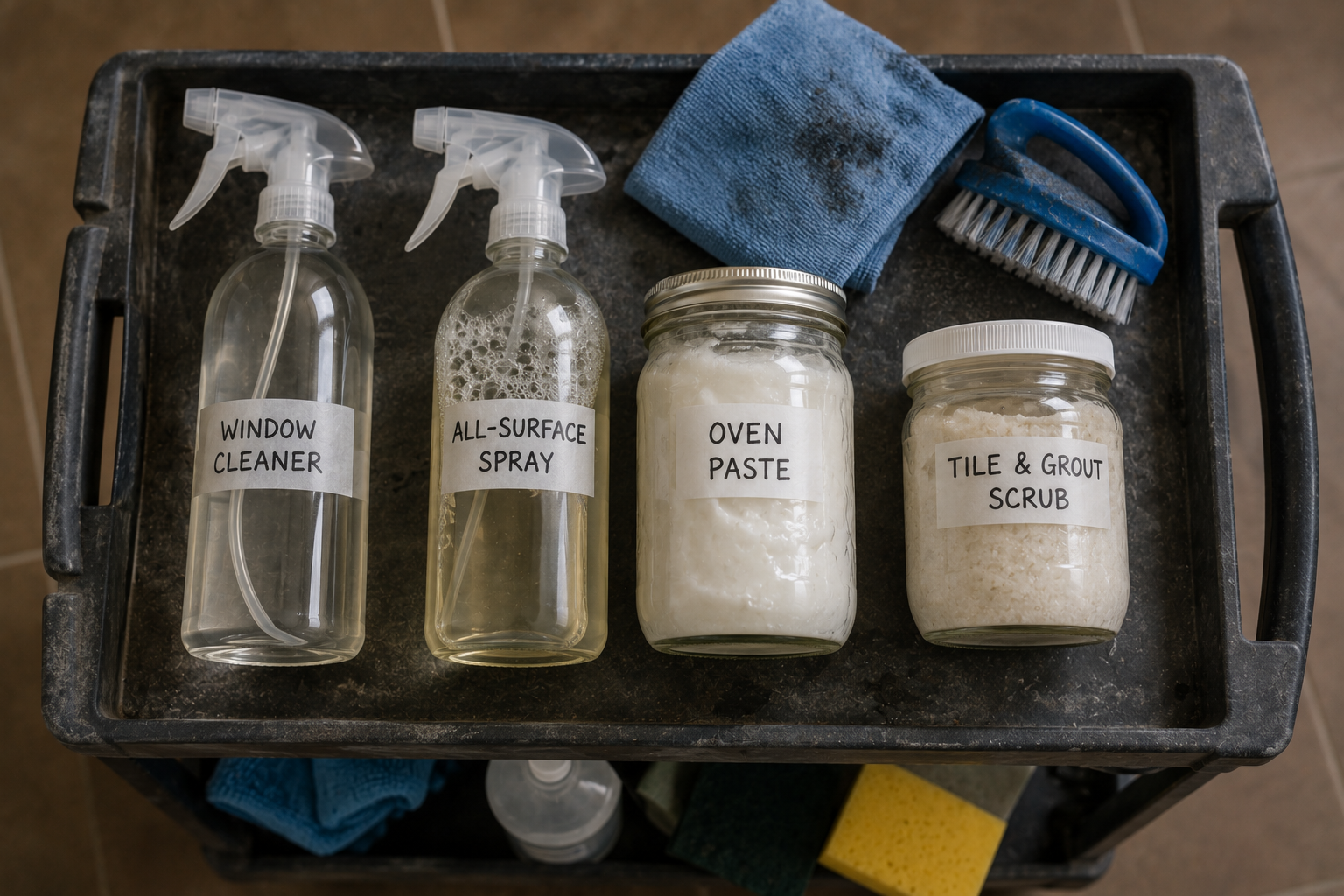
Alright, the good stuff. These are what I make and use.
Tile & grout scrub (baking soda + castile)
My workhorse for tile and grout, and it leans entirely on the "bases are friends" idea:
- 1 cup baking soda
- ¼ cup liquid castile soap (mine, or store-bought, or sub dish soap)
Mix to a thick paste, scoop a little, and scrub it into the sink, tub, or grout lines. Let it sit for 5 to 10 minutes — give it time to actually break down the grime before you go at it — then scrub again and rinse well. The baking soda gives you the gentle grit, the soap lifts and carries the grime off. Rinse thoroughly or you'll leave a gritty film.
Here's a quiet advantage of using my homemade soap for this: I know there are no added dyes or colorants in it. A lot of store-bought soaps carry dyes, and on porous grout a dye can actually settle in and stain the very thing you're trying to clean. Plain soap, plain baking soda, nothing to leave a tint behind.
If you've got heavy hard-water buildup on the tile itself (not the grout), that's a job for a separate vinegar pass afterward — never mixed into this paste, and keep the vinegar off the grout lines.
Oven paste (baking soda — and here's where I was wrong)
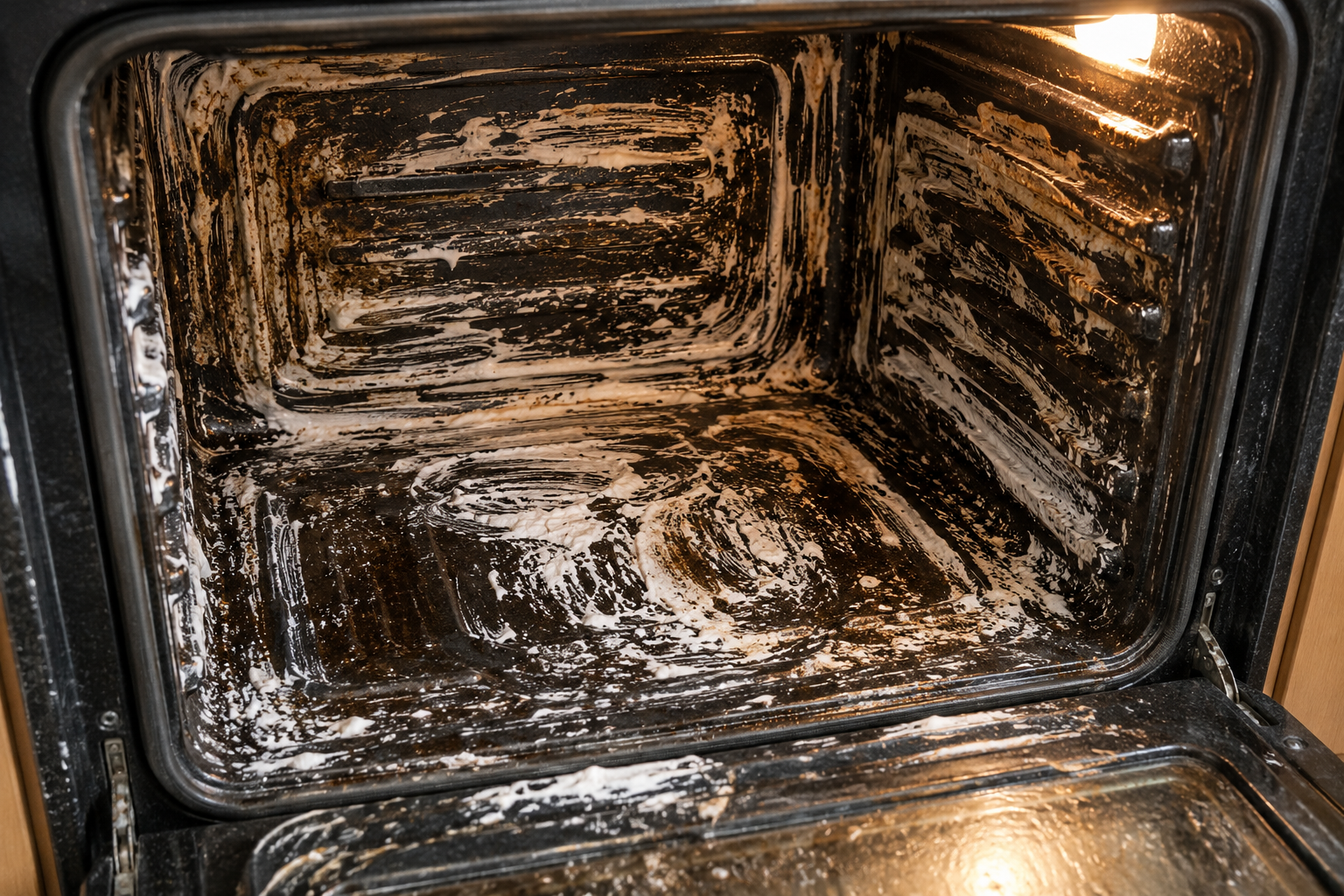
Here's my getting-it-wrong-out-loud moment. When I started, my oven method had a little vinegar in it, and I had a nice-sounding story about the vinegar "loosening" the softened grime at the end. Then I actually dug into it, and — nope. In the oven, the vinegar isn't pulling its weight; the moment it hits the baking soda it just neutralizes into salt water. The real work is being done by the baking soda and, more than anything, by time. So I dropped the vinegar. Here's the honest, better version:
- Make a thick paste of baking soda + water.
- Smear it over the baked-on grime (avoid the bare heating elements).
- Leave it overnight — this is the actual secret, the long sit.
- Wipe it out, scrub the stubborn spots, rinse.
If you want a real booster, the move is hydrogen peroxide, not vinegar. I'm still dialing this one in, and when I've got it perfect I'll write it up on its own.
Window cleaner (vinegar + alcohol)
Genuinely better than the blue stuff, costs almost nothing:
- 2 cups distilled water
- 1 cup white vinegar
- ¼ cup rubbing alcohol
- (optional) a couple drops of castile soap or dish soap for greasy glass
Distilled water matters — tap water's minerals leave the very spots you're trying to get rid of. The vinegar dissolves film and haze; the alcohol flashes off fast so you don't get streaks. One note if you add soap: keep it to a couple drops. This mix is mostly vinegar-and-alcohol, so a tiny bit of soap for cutting grease is fine, but don't turn it into a soap solution — you want it to rinse clean and flash dry. Mist it, don't soak it, and wipe with microfiber. Dust the glass first — spraying onto a dusty window just makes mud, and now you're doing it twice.
All-surface spray (vinegar)
For everyday wipe-downs on the surfaces vinegar likes (glass, sealed counters, chrome, ceramic — not stone, not grout):
- 1 part white vinegar to 1 part water (a 50/50 mix is the standard)
- Go 1 part vinegar to 2 parts water for lighter daily use or more delicate finishes
- A few drops of essential oil if the vinegar smell bugs you (it fades as it dries)
Now the important part: cleaning is not disinfecting
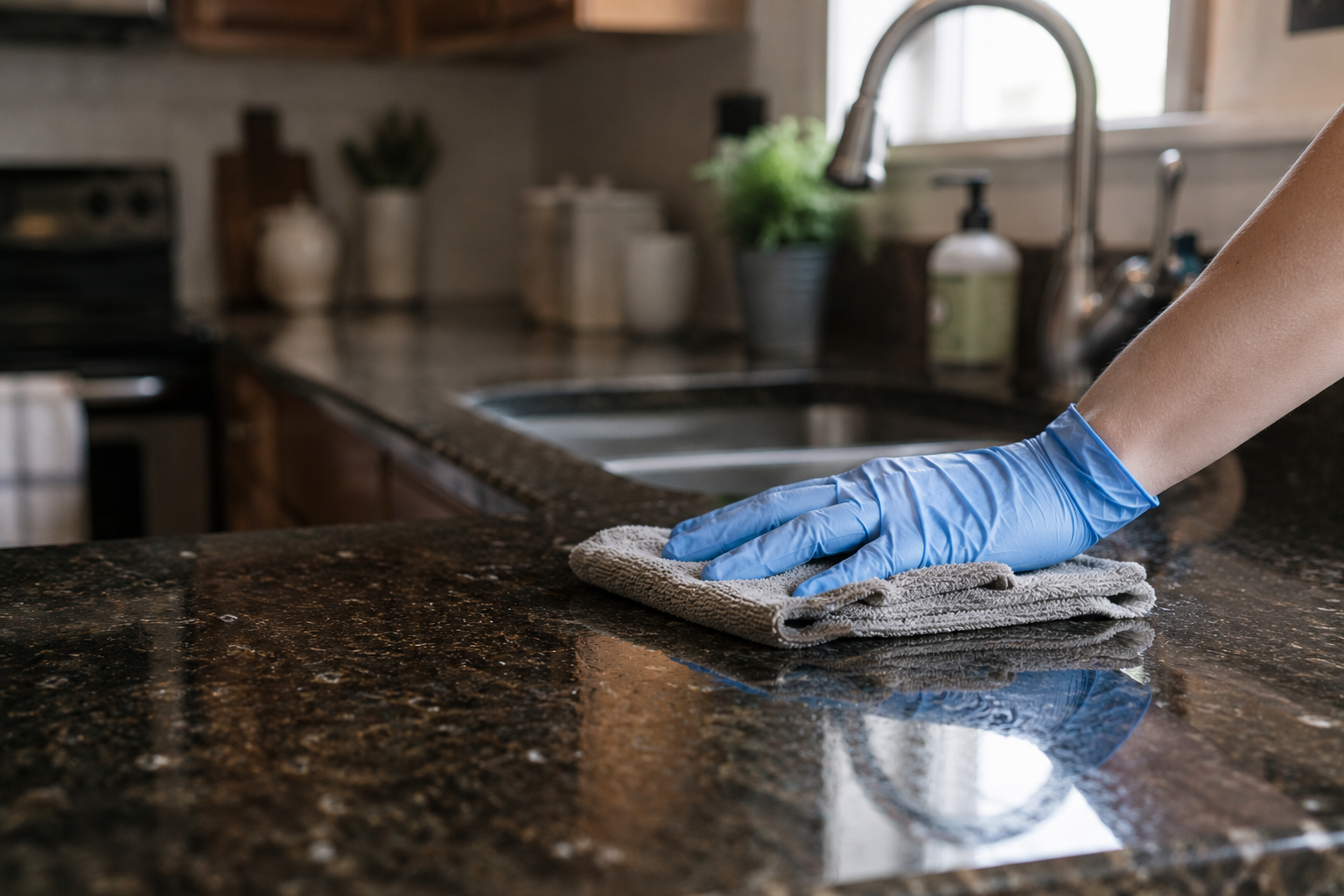
This is where I want to be dead honest with you, because it's where the internet is the most full of it.
Cleaning removes dirt, grease, grime, and a good chunk of germs along with it. Disinfecting kills germs on a surface. They are not the same job. Baking soda, vinegar, and castile soap are cleaners. They are not disinfectants, and I'm not going to dress them up as something they're not to sell you on the "natural" angle.
The science here isn't murky. When researchers put common household products head-to-head against a virus, vinegar and its acetic acid were completely ineffective at inactivating it, while bleach, alcohol, and even plain dish detergent worked. Vinegar has some germ-fighting ability in a lab at the right strength and long contact times, but it doesn't clear the bar to be called a disinfectant, and an older head-to-head study found both vinegar and baking soda knocked out fewer than 3 logs of the test bugs — well short of the commercial disinfectants. So if the goal is truly to kill something, these are the wrong tools. That's just true.
So what should you use if you genuinely need to disinfect? The most effective things out there are chlorine bleach and products like Lysol — no contest on killing power. They're also harsh, and I'd rather not breathe them all day, which is exactly why we don't reach for them as an everyday cleaner. Right tool, right job.
But here's the part I really want you to sit with: most homes, most of the time, do not need every surface disinfected. The goal is a clean home, not a sterile one. The researchers who know this best now talk about "targeted hygiene" — disinfect where it actually matters, and just clean everywhere else. Nuking your whole house with antibacterial product every day isn't buying you much, and it wipes out harmless and beneficial microbes and can even play a role in antibiotic resistance. Chasing a germ-free house is effort spent in the wrong place.
Now — a real and important exception, and this one's personal. I also work as a Home Care Aide (currently for my own aging Omma). When you're caring for someone whose immune system is compromised, the rules change, and they change in both directions. Sometimes you're trained to disinfect the kitchen and bathroom thoroughly to protect a vulnerable person — and sometimes, for someone going through something like cancer treatment, their doctor specifically asks you not to use harsh chemicals like bleach and Lysol around them. There's no one-size answer. If someone in the home is immunocompromised, that's a conversation for their doctor, full stop. Don't take a blog's word for it — not even this one.
What actually keeps a normal kitchen safe isn't nuking the counters — it's good habits. Clean as you go. Keep raw meat away from everything else. Wash your hands. Cook food to temperature.
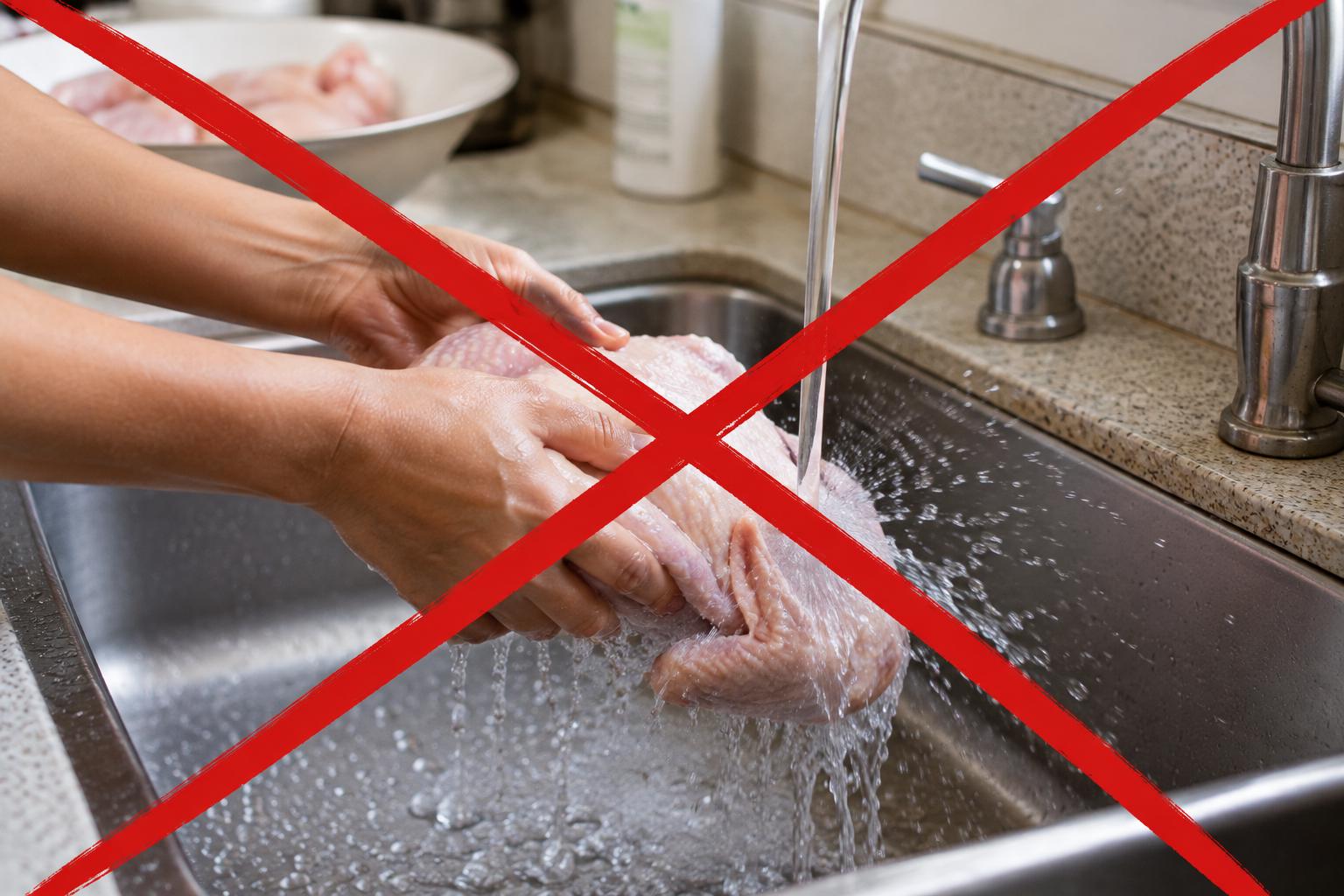
Which brings me to a hill I will happily die on: do not wash your raw chicken. I know your grandmother did it. But rinsing raw chicken doesn't remove the bacteria — it aerosolizes it in a fine spray across your sink, faucet, and counters, and the only thing that actually makes chicken safe is cooking it to temperature. Skip the rinse, clean whatever the raw chicken touched, and you're already ahead of the person who "washed" it.
(And yes, before somebody emails me — I've read the case for wooden cutting boards actually pulling bacteria down into the wood and killing them off better than plastic. So maybe the humble wood board's been the hero this whole time. Point is, this stuff is more complicated than "spray everything and pray," and anybody who tells you they've got it 100% figured out is selling something.)
The short version
If you remember nothing else:
- Baking soda — grease, scrubbing, odors, ovens, and tile/grout. A base.
- Castile soap — lifts dirt and grease; teams up with baking soda for the tile scrub. Also a base.
- Vinegar — hard water, soap scum, glass, windows, all-surface wipe-downs. An acid, and it works alone.
- Bases with bases, acid on its own — never mix vinegar with baking soda, castile soap, or (ever) bleach.
- None of them disinfect — that's a different job with different tools, used only where it's actually needed. And if someone's immunocompromised, ask their doctor.
I'm going to keep expanding what I make myself, and I'll write up the soap recipe and the dialed-in oven method in their own posts. If there's a homemade cleaner you swear by — or one you tried that flopped — tell us. I read everything, and I'm always hunting for the better way.
A few of the sources behind this post, if you want to go down the rabbit hole like I did:
- Almeida et al., "The Efficacy of Common Household Cleaning Agents for SARS-CoV-2," Viruses (2022) — the vinegar-vs-bleach head-to-head.
- Rutala et al., "Antimicrobial activity of home disinfectants and natural products," Infect Control Hosp Epidemiol (2000) — vinegar and baking soda vs. the commercial stuff.
- Bloomfield et al., "Time to abandon the hygiene hypothesis," Perspectives in Public Health (2016) — where "targeted hygiene" comes from.
- Lisa Bronner, "A Word of Caution About Vinegar and Castile Soap" — why the curdle happens, from the Bronner family themselves.
- The Society for the Preservation of Irish Soda Bread and Max Miller's Tasting History, "Irish Soda Bread from 1836" — the baking soda history.
- CDC, "Chicken and Food Poisoning" — seriously, don't wash it.