2026-10-21
Show Up and Do What You Said You Were Going to Do

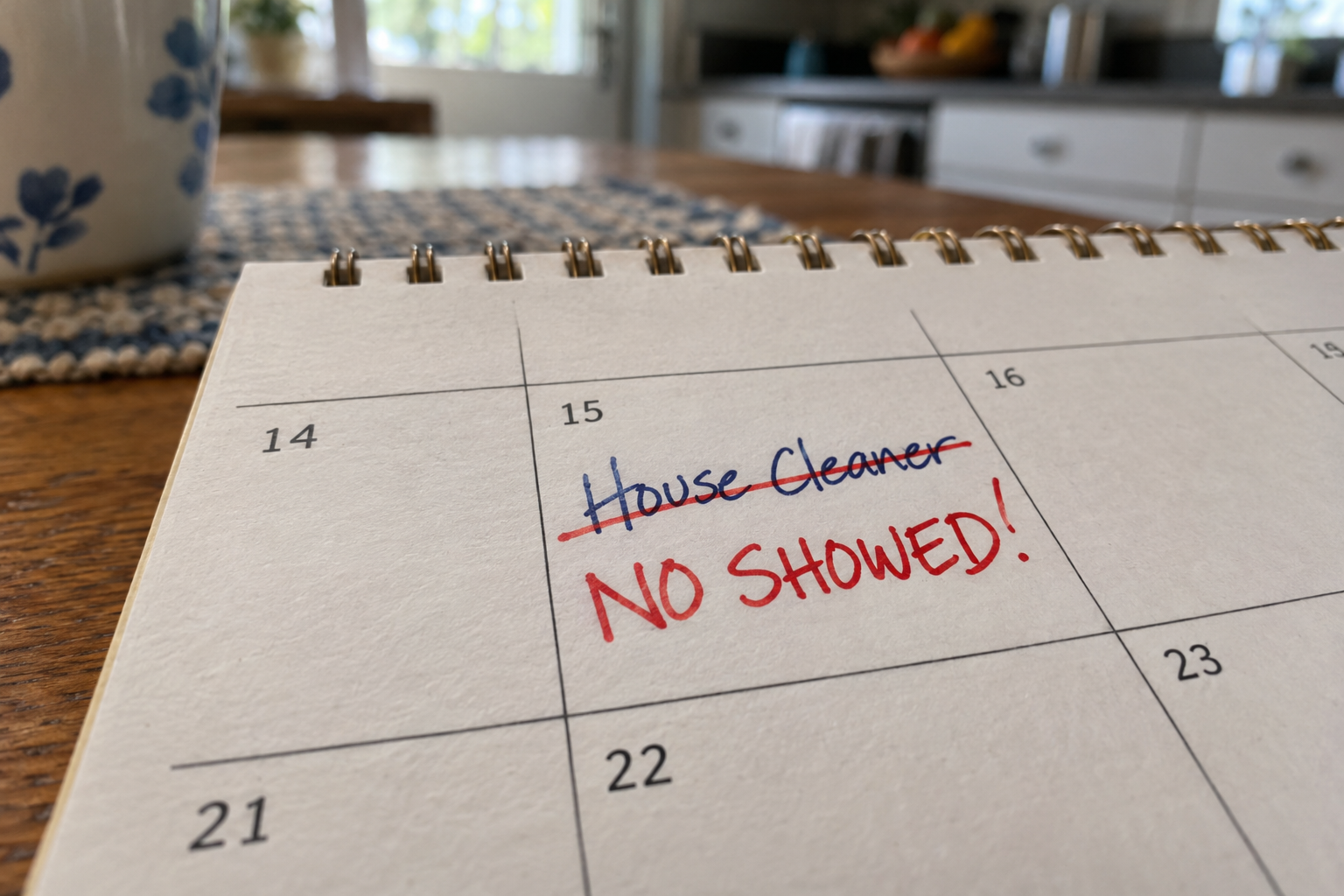
The bar in the cleaning industry is on the floor. Not the quality of work (though that's its own conversation). The most basic act of operating a business: showing up when you say you're going to show up.
Nearly every new client tells some version of the same story. The cleaner who just stopped coming. No call, no text, no explanation. The company that gave them a three-hour arrival window, forced them to rearrange their entire day, and then didn't show up at all. The solo operator who did good work the first couple times and then started arriving later and later until they just vanished.
These aren't rare stories. These are the stories. This is what people expect from this industry now. They expect to be let down.
That should bother every small cleaning company operator reading this. When a client says something like "well, we'll see if you actually come back" during a walkthrough, that's not skepticism born from nothing. That's earned distrust, and somebody else earned it.
The numbers behind the no-show problem
An analysis of 1,000 negative reviews of cleaning companies by MaidForYou (an Australian cleaning company that did the work of hand-categorizing every single one) found that the most common complaints were not about cleaning quality. They were about operational reliability. No-shows. Last-minute cancellations. Broken schedules. The finding that stands out: customers were far more forgiving of imperfect cleaning than they were of a broken appointment. They could tolerate a streaky window. They could not tolerate being stood up.
According to industry benchmarks, the average no-show rate in home services runs between 12 and 18 percent. That means somewhere between one in six and one in eight appointments just doesn't happen. For a service that requires someone to be home, or at least to have made arrangements for access, that is a staggering number.
And this isn't coming from one type of company. It happens with solo operators. It happens with the big franchise operations that give you a three-hour arrival window (which is its own problem, because nobody can build a life around waiting three hours for something that might not happen).
The research confirms what most clients already know: reliability and trustworthiness are the most important factors when hiring cleaning services, because you're inviting a stranger into your home. And the number one way that trust gets broken isn't by leaving a streak on a mirror. It's by not showing up.
What clients actually say
The stories from clients who've switched to Scrubsquad from other companies are remarkably consistent. Some version of:
- "They just stopped showing up. No heads-up, no follow-up. We were ghosted."
- "They gave us a window and then didn't come. We sat around the whole morning."
- "The first couple cleans were fine, then they started being late, then really late, then they just didn't come."
When somebody tells you "we'll see if you actually come back," they're not being rude. They've been trained by the industry to expect exactly that. Every operator who ghosted a client or blew off a scheduled appointment made it harder for the next company to earn trust.
Scrubsquad is still exploring arrival windows, but if we go that route, it'll be 30 minutes, not three hours. Nobody should have to burn half a day waiting for the person they're paying to come to their house.

What "on time" actually means
There's a saying from my years on tall ships: being early is on time, being on time is late, and being late is unacceptable. That sounds intense when you apply it to residential cleaning. Nobody expects military-grade punctuality from the person cleaning their kitchen. But the principle underneath it isn't about rigidity. It's about respect.
When a client blocks out time in their day for you, when they make arrangements around your arrival, when they hand you a key or a garage code, they are trusting you with their time and their home. Showing up when you said you would is the absolute minimum way to honor that trust.
When the standard slips (because it does)
I need to tell this story because I can't write about integrity and leave out the time I failed at it.
My calendar app had a recurring error with one particular client's appointment, and I missed it. Not once but twice. This client was upset, and they had every right to be. They had rearranged their schedule around my arrival. They had trusted me to be there. And I wasn't. Twice.
I took accountability the only way that felt right: I made it cost me something. I serviced their home at no charge. Not because they asked for it, not as a promotional gesture, but because my failure had cost them their time, their trust, and their patience, and the least I could do was make sure it didn't also cost them money.
That client is still with us. We have a great working relationship going on two years now. But it still bothers me. Not the financial part. That was the right call. What bothers me is the failure of integrity. Mine. Twice.
The broader point isn't about any particular remedy. It's this: when you tell someone you're going to be there, and you're not, that costs them something real. Their time. Their plans. Their trust. And if you're in this business and you don't feel the weight of that, you should examine whether you're in the right business.
Know what you don't know (and refer the people who do)
Integrity isn't only about showing up on time. It's also about not saying yes to things you can't deliver.
A client recently asked about pressure washing their gutters. The answer was no. Not "maybe," not "let me figure it out and get back to you." No. The insurance doesn't cover it. The experience isn't there. Saying yes would have been taking money for a job that couldn't be done well, and risking damage in the process.
That's hard for a small cleaning business. Every job feels like it matters, especially early on. There's a voice in your head that says "just figure it out, don't lose the work." But taking on a job you're not equipped for, not insured for, or not experienced enough to do well is one of the fastest ways to erode exactly the trust you're trying to build. You do a poor job, or worse, you cause damage. And now you've lost not just that one job, but that client's confidence in everything else you do.
The better move, the one that I've found that actually builds your business long-term, is to know your scope, be honest about it, and have a reliable referral ready. When someone asks about something Scrubsquad doesn't do (carpet shampooing, pressure washing), the answer is straight, along with a recommendation for someone who specializes in it. Over time, that builds a network of trusted contacts, and it builds a reputation as a company that would rather tell you the truth than take your money.
If you're a fellow small operator reading this: build that referral list. It's one of the most valuable things you can have. When you send a client to a specialist who does great work, that client remembers you sent them there. That’s how people start trusting you, not by overextending.

The hiring problem
Starting a cleaning company, you expect certain challenges. Building a client base takes time. Learning the business side takes work. What I didn't realize is how hard it would be to find reliable people.
And the problem is not pay. Scrubsquad pays well above the industry standard. The national median wage for maids and housekeeping cleaners is about $17.07 per hour according to the Bureau of Labor Statistics. In the Seattle-Tacoma-Bellevue area, it's higher, around $21.59 per hour. Scrubsquad pays well above that. I go into our pay philosophy in Why We Started Scrubsquad. The short version is: this isn't a pay problem.
Here's what actually happens:
Over 90% of applicants ignore the basic asks in the job posting: send a resume, provide references, tell us about yourself and your experience. Those aren't hoops to jump through for fun. They're the first signal of whether someone reads instructions and follows through. When nine out of ten applicants can't clear that bar, you start to understand the scope of the problem.
Of the remaining small percentage who do meet the qualifications, the majority don't show up for the interview.
Of the ones who do show up, some are significantly late.
And for the few who make it through all of that and get hired, some show up hours late to job sites. Some don't show up at all. Some ask to leave early but expect full pay.
The cleaning industry as a whole has a turnover rate of roughly 42 percent, according to ISSA data. For contract cleaning companies, the BSCAI has reported historical turnover as high as 100 to 400 percent. That means some companies are replacing their entire workforce multiple times a year. The estimated cost to replace a single frontline cleaning worker is $1,500 to $3,000 when you add up recruiting, hiring, training, and the productivity gap while someone new gets up to speed. And 78 percent of cleaning companies report difficulty hiring.
Those numbers aren't shared to complain. They're the reality of this industry, and if you're a client reading this, they're part of why reliability is so rare and why you should pay attention when you find a company that actually delivers it.
Here's the part that stands out the most: several applicants who no-showed or showed up late to job sites run their own cleaning businesses. Some of them said they have difficulty retaining clients. And some of them connected the dots themselves, saying they think their lateness might be part of it. That is a big deal. If you can see the connection between not showing up and losing clients, and you still can't fix it, the problem isn't logistics. It's integrity.
Finding people who share this standard is a slow and careful process. It has to be, because cycling through people who no-show spills over onto clients' lives. That's the honest truth.
Why this matters (beyond just being on time)
Integrity is the moat. It's the thing that can't be copied, can't be scaled cheaply, and can't be faked. The absentee-owned companies, the ones backed by outside money with call centers and three-hour windows and skeleton crews, they can undercut your price. They can outspend you on ads. They can show up on the first page of Google when you're still trying to figure out SEO. But they cannot make the person who shows up at a client's door care about being there. They cannot manufacture the relationship between a cleaner who takes pride in their work and a client who notices. That has to be real.
So if you're a small operator or a solo cleaner, and you show up on time, every time, and you do what you said you were going to do, you already have something that most of your competition doesn't. That's not a low bar. That's a foundation. Build on it.
And if you're a client or potential client reading this, here's what matters: when you find a company that shows up, that communicates, that does what they said they'd do, tell people about them. Leave a review. Refer them to your neighbor. The companies doing it right in this industry are fighting an uphill battle against an entire culture of unreliability, and the thing that helps them most is people who notice the difference.
If you're a small operator trying to build something real in this industry, keep going. And if you're a homeowner who's been burned before, you deserved better. We're trying to be better.
Contact Us: (253) 765-8077 | info@seattlescrubsquad.com
Sources:
- MaidForYou, "We Analysed 1,000 Negative Cleaning Reviews. The Biggest Problem Is Not Quality", February 2026. Analysis of 1,000 negative reviews of Australian cleaning companies, finding that operational reliability complaints (no-shows, last-minute cancellations) were more common than cleaning quality complaints.
- SchedulingKit, "Average No-Show Rates by Industry", 2026. Home services average no-show rate: 14.7% (range 12-18%).
- U.S. Bureau of Labor Statistics, Occupational Employment and Wage Statistics, May 2025. National median hourly wage for maids and housekeeping cleaners: $17.07. Seattle-Tacoma-Bellevue median: $21.59/hour ($44,900/year).
- ISSA Cleaning Industry Market Report, 2025. Cleaning industry turnover rate: 42%. 78% of cleaning companies report hiring difficulty. Cited via SchedulingKit Cleaning Services Industry Statistics.
- Building Service Contractors Association International (BSCAI), industry surveys. Historical cleaning industry turnover: 100-400% pre-2020 for contract cleaning. Cited via CleanLink.
- Netchex, "Turnover in Janitorial and Cleaning Services", June 2026. Estimated replacement cost per frontline cleaning worker: $1,500-$3,000.
- SchedulingKit, "Cleaning Services Reviews", 2026. Reliability and trustworthiness as top factors in hiring cleaning services.